
How recycling works in Barcelona
A few years ago while on a guided tour of Barcelona with some Chinese customers who came to the city to attend a conference, I was surprised that at one point during the tour, while walking through the Eixample neighborhood, they began to take pictures of some rubbish bins. I had never encountered this situation before. Even today I still don’t know very well what caught them the attention. Was it the design? Or perhaps the concept itself, that the city has at its disposal recycling bins.
The fact that the containers aroused the curiosity of these Asian visitors made me think about it. As a guide I am used to explaining art, architecture, history, culture, traditions, gastronomy of my country. But I realized that there are many other things, also important, that work differently in each country, and one of them is the issue of recycling.
This fact, plus the desire to contribute my bit to the preservation of the environment, has moved me to write this article and to incorporate information about the recycling system used in Barcelona in my explanations to tourists.
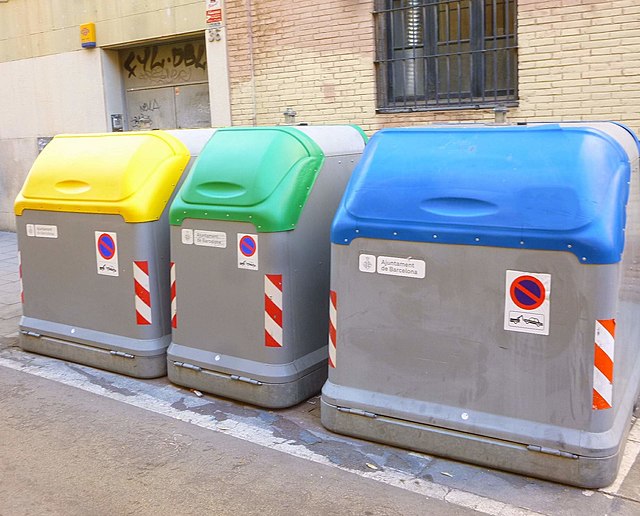
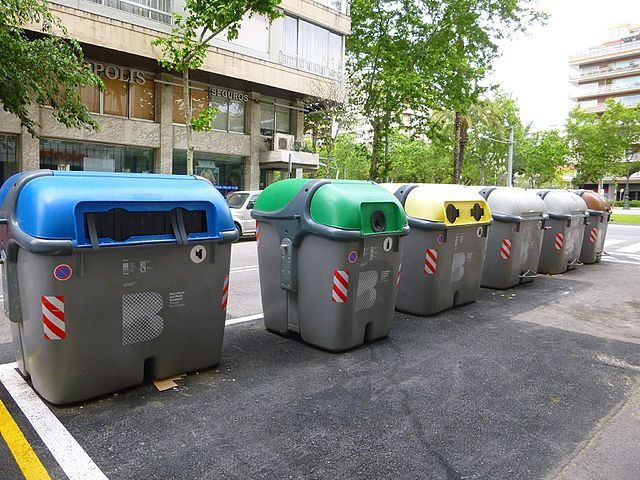
Recycling bins in Barcelona and Spain
If, during your visit to Barcelona or any town in Catalonia or Spain, you are staying in an apartment, house, or other accommodation, you will likely generate waste, so knowing how waste separation works can be useful.
Walking around Barcelona, as in so many other cities, we often find a set of 5 containers of 5 different colors next to the sidewalk and near apartment buildings and shops.
The design and size of these containers vary by town, since it is each municipality’s responsibility, but the meaning of each color is the same.
The colors of the containers
- ⇒The green container is for glass: bottles and jars.
- ⇒The blue container is for paper and cardboard.
- ⇒The yellow container is for plastic packaging such as bottles, bricks, cans, and plastic bags.
- ⇒The brown container is for organic waste such as food and gardening waste, as well as cork stoppers.
- ⇒The grey container is for the rest of the waste not included in the other categories.
The optimal time to dispose of garbage, especially organic waste, to avoid bad odors, is between 8 and 10 p.m.
The 3 R’s: Reduce, Reuse, and Recycle
Currently, just recycling is no longer enough, and we have to go one step further. In schools, children learn the Rule of 3 R´s from a very early age: Reduce, Reuse, and Recycle. Three actions, three attitudes that, in the same order, should guide our daily lives. Keeping it in mind and carrying it out in day-to-day actions, we show our love for the planet and for the preservation of the environment.
This 2021 at STLB we are taking advantage of the break in our profession caused by the global pandemic. We are working to get the Biosphere Tourism certification. If you like to know a little more about this certification, click on our presentation.
Other waste collection systems in Barcelona
Likewise, in Barcelona, there are 2 more waste collection systems for citizens.
- The “Green Points” in Barcelona
Green points are used to get rid of waste that can’t be thrown into street containers. Green points can be mobile and fixed. Each neighborhood has its own.
Elements which you can bring: flat glass, appliances, debris, clothing, footwear, ink cartridges, toners, electrical and electronic appliances, cooking oils, electrical cables, small tires, aerosols and sprays, car batteries, cosmetics, x-rays, batteries, motor oils, paints and varnishes, fluorescents and light bulbs, single-dose coffee capsules (plastic and aluminum), etc.
- Old furniture and junk collection
The old furniture and junk collection service helps to improve the quality of the streets. Each district of Barcelona has a specific day of the week for the collection of bulky household waste. It is important to leave the furniture on the scheduled day of the week in front of the doorstep between 8 and 10 p.m.
Type of collected objects: sofas, doors, furniture, chairs, boxes, wooden slats, blinds, or broken toys, among others