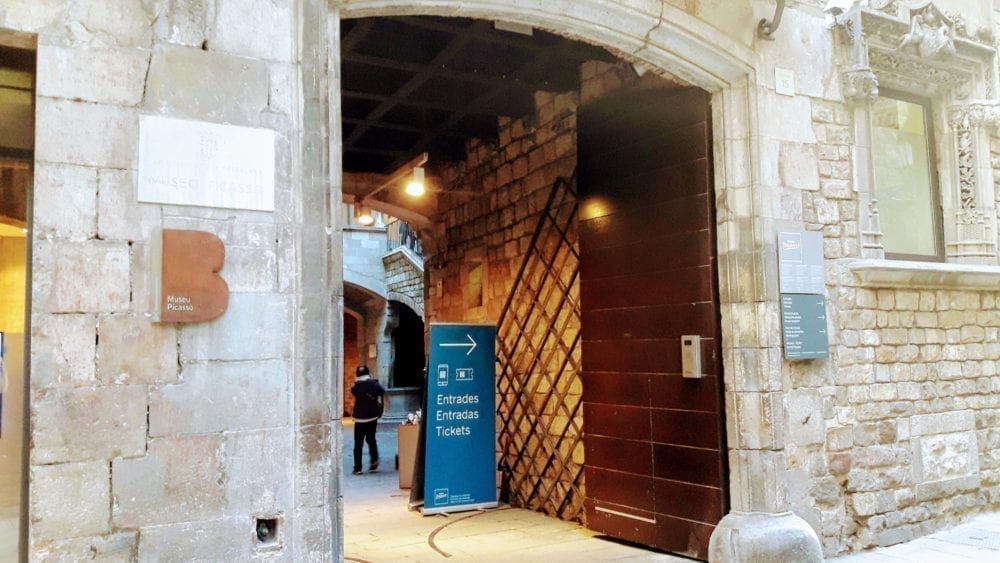


Is the Picasso Museum in Barcelona worth it?
Our answer is YES, and a private guided tour is even better. It is a Museum where you can discover Picasso’s learning process and how important his father was during his early years as an art student. The Museum is a donation of Jaume Sabartés (his personal secretary and one of his best friends) and Pablo Piasso himself. Some of the paintings never left Barcelona because they were on the walls of his mother’s house here. A nice collection of ceramics and temporary exhibitions are other good reasons to visit the Museum.
After the guided tour many of our customers have changed their idea of Picasso’s art.
Where is the Picasso Museum in Barcelona located?
The Picasso Museum of Barcelona is located on Carrer de Montcada, a very important street during the Middle Ages. In the XII-XIII centuries, it was a very elegant street lined with large Gothic palaces inhabited by noble families of the time.
Due to its importance, this street was among the widest in the city, and it has been well preserved to this day.
All these ancient palaces follow a very similar construction typology: they are made of stone, with a large entrance door to allow the passage of carriages, a “patio” or open courtyard, and a well to collect rainwater.
On this ground floor, we find the spaces intended to house the kitchen, the cowsheds or stables, the food warehouses, and the grain silos. There was also a staircase to access the main floor, the most elegant one, where the living room for visits was located. A second floor for the bedrooms and the upper floor for the domestic service.
These palaces were remodeled in the 1960s to house the Picasso Museum, which opened in 1963, ten years before the artist´s death. The museum is located in these 5 connected palaces.
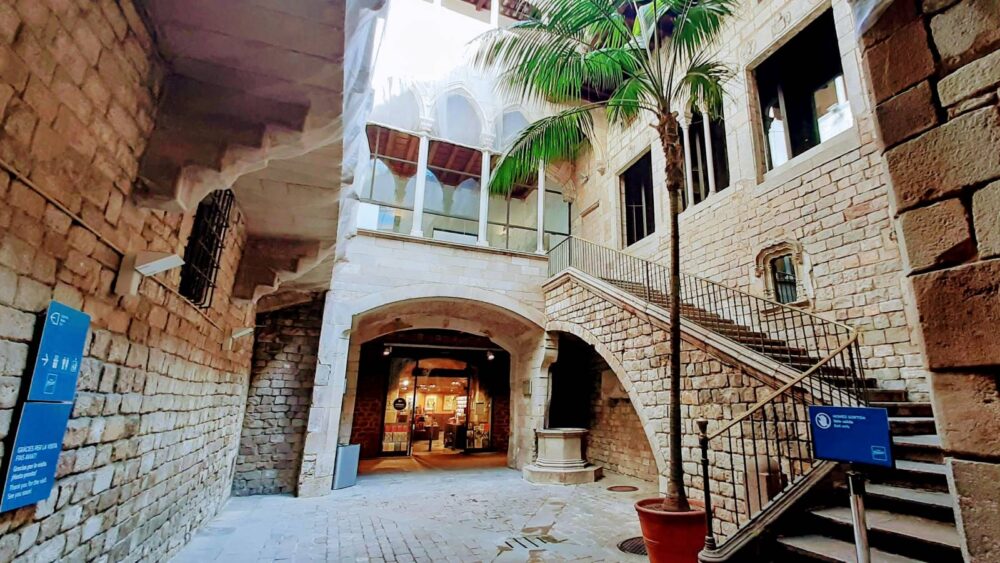
Origins of the Picasso Museum in Barcelona
The Picasso Museum in Barcelona opened in 1963 thanks to the will of Jaume Sabartes, Picasso’s personal secretary and great friend. This is why the museum was originally called “Col. lecció Sabartés”. Unfortunately, Picasso did not have the opportunity to visit his own museum, as he was against the Franco regime. He declared that he would not return to Spain until the end of this regime. He passed away two years before this happened.
The exhibited works follow a chronological order, so it is ideal to know the beginnings, the origins of Picasso, to discover his period of formation, and academic, and to appreciate the evolution of his technique and his style.
If you want to take a guided tour of the Picasso Museum in Barcelona, we offer a 1.5-hour tour in English accompanied by an official guide.